Why Your Child’s Prescription Keeps Changing: Understanding Myopia Progression
Dr. Tina Goodhew
May 5, 2026
Every year, the story is the same. You bring your child in for their eye exam, and once again, a stronger prescription is given. Maybe you’ve started to wonder: is this normal? Will it ever stop? And is there anything you can actually do about it? If this sounds familiar, you’re far from alone. Childhood myopia, or more commonly known as nearsightedness, is one of the most rapidly growing health concerns affecting children worldwide, and a changing prescription year over year is one of its most common warning signs. Here’s the good news: understanding why this happens is the first step toward doing something about it.
What Is Myopia Progression and Why Does It Happen?
Myopia happens when the eye grows slightly too long. Instead of light focusing neatly on the retina at the back of the eye, it falls just in front of it which makes distant objects appear blurry while close-up vision stays clear.
In children, this isn’t a static condition because their entire body including the eye is actively growing, and in myopic children, their eyes grow faster than they should. Each millimetre of extra eye length shifts the focal point further off-target, which is why the prescription gets stronger. This ongoing process is called myopia progression, and it tends to be most rapid between the ages of 6 and 14 and can sometimes even continue up to the early 20’s.
Several factors can accelerate this progression:
Genetics
Having one myopic parent roughly doubles a child’s risk. Two myopic parents makes it four to six times more likely.
Near work
Prolonged reading, homework, or screen time keeps the eyes locked in a close-focus position that may accelerate elongation.
Limited outdoor time
Children who spend less time outdoors tend to progress faster.
In short, myopia progression is a biological process tied to how your child’s eyes grow. And while you can’t stop growth altogether, you can often slow it down dramatically.
The Real Risk – It’s Not Just About Thicker Lenses
It’s tempting to think of a stronger glasses prescription as nothing more than an inconvenience. But there’s an important distinction between myopia as a vision inconvenience and myopia as a health risk. The difference between the two becomes much more significant at higher prescriptions with the risk of the following becoming more of a concern:
Retina Detachment
High myopia significantly increases the likelihood of the retina pulling away from the back of the eye.
Macular Degeneration
The stretching of a highly elongated eye can damage the macula, the part of the retina responsible for central vision.
Glaucoma & Cataracts
Both conditions are more common in highly myopic individuals.
“Every diopter of myopia that is prevented matters. Research suggests that reducing final myopia by even 1.00 D can significantly lower the risk of sight-threatening complications in adulthood.”
How Axial Length Measurement Tells the Full Story
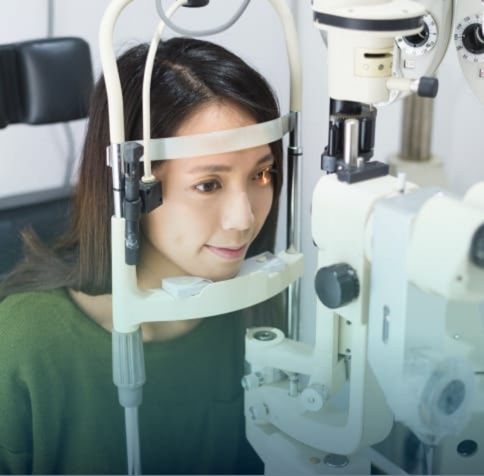
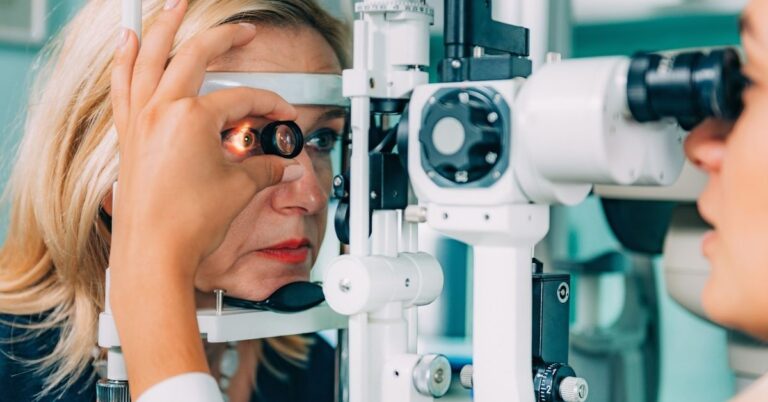
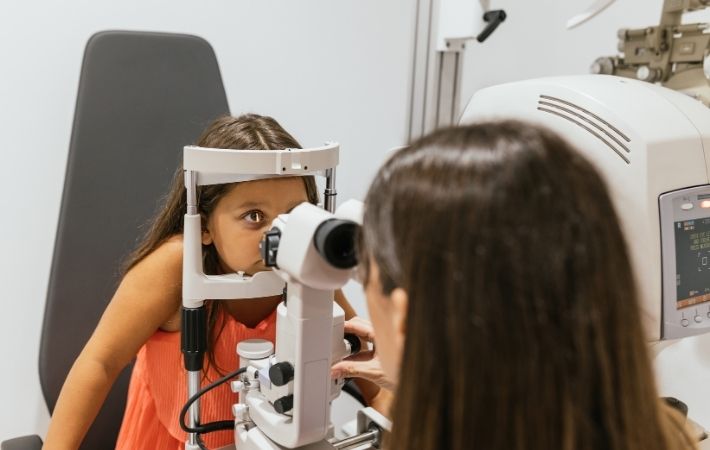
The standard eye exam measures visual acuity which is how clearly your child can read the letters on the eye chart and determines the prescription needed to correct it. What it doesn’t always tell you is how fast the eye itself is growing. That’s where axial length measurement comes in.
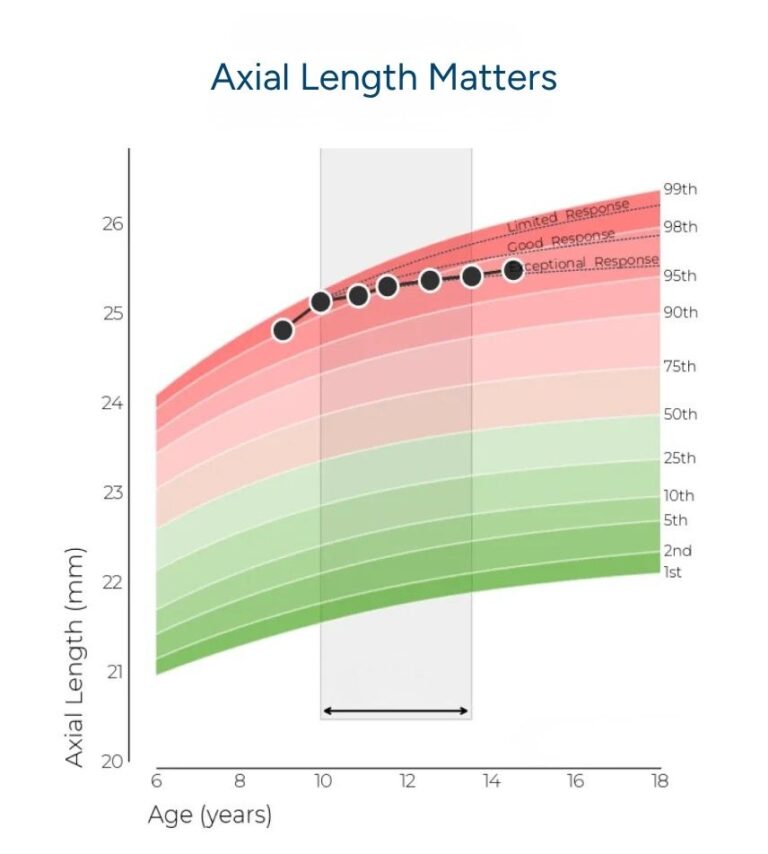
Axial length is simply the physical length of the eye from front to back, measured in millimetres. In a healthy adult eye, this is approximately 24 mm. In a myopic eye, it’s longer, and in a progressing child, it’s measurably longer from one visit to the next.
By tracking axial length over time, your optometrist can:
- Detect progression earlier, even before the prescription changes significantly.
- Measure the true rate of eye growth, not just the visual result.
- Make more precise decisions about which myopia management treatment is appropriate.
- Evaluate whether a treatment is actually working to slow the eye growth.
Think of it this way: a prescription change tells you the score at the end of the game. Axial length measurement lets you watch what’s happening on the field in real time.
When to Talk to Your Optometrist About Myopia Management
If your child has been myopic for a year or two and their prescription is climbing, the conversation about myopia management is worth having now, not after another two or three progressions.
Here are some signs that it’s time to ask specifically about myopia management:
- Their prescription has increased by 0.50 D or more in the past year
- Myopia began before age 10
- One or both parents are myopic
- Your child spends limited time outdoors and significant time on screens or close work
- They are already approaching −4.00 D or beyond
It’s also worth knowing that myopia management isn’t a single product or a one-size solution. Effective options include specialty contact lenses, myopia control spectacle lenses, low-dose atropine eye drops, and orthokeratology which are overnight lenses that reshape the cornea while your child sleeps. The right approach depends on your child’s age, prescription, rate of progression, and lifestyle, which is exactly why a thorough myopia assessment matters.
BOOK YOUR CHILD’S EYE EXAM
Wondering whether your child’s vision has changed, or whether they might benefit from a myopia management plan? Our team at Abbey Eye Care in Oakville stays at the forefront of pediatric eye care and myopia management, and we’d love to help your family see the bigger picture. Book an eye exam today and let’s make sure their eyes are growing in the right direction.
OUR MYOPIA CLINIC
Worried about your child’s prescription climbing year after year? Our dedicated Myopia Clinic
offers proven management options which include: Spectacle lenses, Ortho-K, specialty soft contact lenses, and atropine therapy, all designed to slow myopia progression and protect the long-term eye health of you child.