Outdoor Play and Myopia Prevention: The Two-Hour Rule Every Oakville Parent Should Know
Dr. Tina Goodhew
May 24, 2026
If your child has been spending more time indoors than out, you’re not alone and there’s some genuinely good news worth sharing. Researchers around the world have discovered that something as simple as daily outdoor play can dramatically lower a child’s chance of becoming nearsighted. For Oakville families, this is one of the most empowering pieces of eye health science to come along in years.
The Evidence: How Sunlight Protects Developing Eyes
Myopia, or nearsightedness, develops when a child’s eyeball grows too long, which in turn causes distant objects to look blurry. Once it begins, it tends to progress through the school years, but a growing body of research shows that we may be able to delay it from starting in the first place. Large-scale studies in Australia, Taiwan, and China have all reached the same conclusion: children who spend more time outdoors are significantly less likely to develop myopia than children who spend most of their day indoors.
The protective ingredient appears to be natural daylight itself. Sunlight is far brighter than any indoor lighting, even on a cloudy day and exposure to that brightness seems to trigger the release of dopamine in the retina, a chemical signal that helps regulate healthy eye growth. The strongest studies suggest that 90 to 120 minutes of daily outdoor time can reduce a child’s risk of developing myopia by as much as 50%. That’s a remarkable return on a habit that costs nothing and benefits children’s overall health at the same time.
Strong evidence for prevention
In children who haven’t yet developed myopia, increasing outdoor time meaningfully delays its onset. The earlier the habit starts, the greater the protective effect, thus making the preschool and early-elementary years especially valuable.
Less effect on progression
For children who are already nearsighted, outdoor time alone doesn’t reliably slow further progression. These children benefit most from clinical myopia management, the kind of care your Abbey Eye Care Optometrist can tailor to them.
Two Hours a Day: Making It Work for Busy Oakville Families
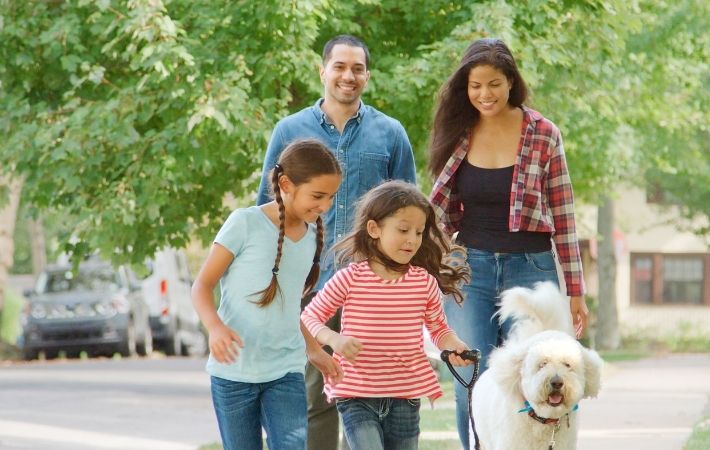
Two hours a day can sound daunting on a Tuesday in November in Oakville, but the research isn’t asking for two unbroken hours of structured outdoor activity. Time spent outdoors counts whether your child is kicking a soccer ball, walking to school, eating lunch on the back porch, or simply reading on a blanket in the backyard.
The key is to weave outdoor moments throughout the day rather than treat them as a single big task. A walk to school, recess, after-school playtime in the yard, and a short evening stroll can easily add up. Weekends, when families have more flexibility are also a great chance to make up ground with longer outings to local parks or trails which are abundant here in Oakville.
“Outdoor time doesn’t have to be sporty or scheduled. Daylight on the eyes, through everyday moments outside, is what makes the difference.
Outdoor Activities in Oakville That Double as Eye Protection
One of the lovely things about raising kids in Oakville is how much of the town invites you outdoors. Here are a few favourites our patients tell us about, each one easily turns into the daily dose of daylight your child’s eyes need:
- Walks along the lakefront. The waterfront trail from Coronation Park toward Bronte Heritage Waterfront Park gives kids open sky, fresh air, and plenty to look at, perfect for a weekend stroll in any season.
- Time in our larger green spaces. Sixteen Mile Creek and Lions Valley Park offer wooded trails, creeks to explore, and a natural play space that suits a wide range of ages.
- Neighbourhood park visits. Smaller spots like Wallace Park and Joshua’s Creek Park are easy to fit into a weeknight after dinner, even 20 minutes adds up.
- Active commuting. Walking or biking to school instead of driving is one of the simplest ways to bank outdoor minutes without rearranging your day.
- Seasonal outdoor activities. Skating on outdoor rinks, sledding at local hills, splash pads in the summer, and apple-picking trips in the fall all qualify, daylight is daylight, even when it’s cool out.
- Backyard and porch time. Reading, snacks, and homework can all move outside on nicer days. The eyes don’t mind what your child is doing, they benefit from the light either way.
Small, repeated outdoor moments tend to stick better than ambitious one-off plans, so build the habit into the routines that already work for your family.
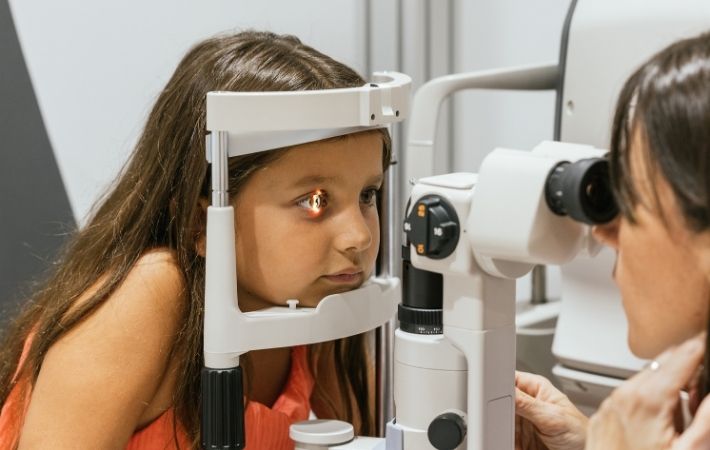
Once myopia has begun, the eye is already on a particular growth trajectory, and outdoor time alone usually isn’t powerful enough to change that course. This is where evidence-based myopia management comes in. Treatments such as specially designed soft contact lenses, orthokeratology (overnight contact lenses), novel spectacle lens designs or low-dose atropine drops can meaningfully slow progression.
The takeaway isn’t that outdoor time stops mattering, it still supports overall eye health and well-being. But for a child who is already nearsighted, the most effective protection comes from pairing daylight habits with a personalized plan from your optometrist. At Abbey Eye Care, we offer myopia management plans tailored to each child’s age, prescription, and lifestyle.
FAQ’s
Does outdoor time still help if it’s cloudy or winter in Oakville?
Yes. Even on overcast days, outdoor light is many times brighter than indoor lighting, and that brightness is what appears to protect developing eyes. Bundle up and keep going outside year-round, the benefit doesn’t pause for winter.
Do my child’s eyes need direct sunlight, or is shade okay?
Shade is perfectly fine. In fact, time under a tree canopy or on a shaded porch still delivers far more light than indoor settings. Direct sun isn’t required, and protecting young skin and eyes from harsh midday sun is still a good idea.
Can screen time outdoors count toward the two hours?
Time outdoors is what matters most, and being outside while using a screen is still better than being inside. That said, screen-free outdoor activities encourage looking into the distance, which gives the eyes the kind of break that close-up work doesn’t.
At what age should we start building outdoor habits?
As early as you like. The protective effect appears strongest before myopia begins, which for many children is between ages 6 and 10 however but earlier outdoor habits build a strong foundation, and there’s no age at which time outside stops being good for kids.
BOOK YOUR CHILD’S EYE EXAM
Wondering whether your child’s vision has changed, or whether they might benefit from a myopia management plan? Our team at Abbey Eye Care in Oakville stays at the forefront of pediatric eye care and myopia management, and we’d love to help your family see the bigger picture. Book an eye exam today and let’s make sure their eyes are growing in the right direction.
OUR MYOPIA CLINIC
Worried about your child’s prescription climbing year after year? Our dedicated Myopia Clinic
offers proven management options which include: Spectacle lenses, Ortho-K, specialty soft contact lenses, and atropine therapy, all designed to slow myopia progression and protect the long-term eye health of you child.