Red Light Therapy for Myopia: A Promising Treatment Under the Microscope
Dr. Tina Goodhew
May 26, 2026
If you’ve been researching myopia treatments lately, you may have come across something called red light therapy, a newer approach that’s been generating a lot of conversation in parent groups, news articles, and online forums. The early results are genuinely exciting, but recent safety research has added important nuance to the picture. Here’s what we know so far, and what we think Oakville parents should keep in mind before considering it for their child.
The Clinical Evidence Showing Impressive Early Results With Important Caveats
Repeated low-level red-light (RLRL) therapy involves having a child look briefly into a small device that emits a soft red light at a specific wavelength around 650 nanometres, for three minutes, two times per day, five days a week. The first major randomized clinical trial, published in 2024, reported that this regimine reduced axial elongation (the lengthening of the eyeball that drives myopia) by roughly 53% over the course of one year, compared with children who didn’t receive the therapy. Subsequent trials in China and elsewhere have largely echoed those findings, making RLRL one of the most effective myopia control interventions ever measured in a clinical trial.
However, the picture is more complicated than the headlines suggest. Most of the trials have been conducted in East Asian populations, with relatively short follow-up periods, and questions remain about what happens when treatment stops. Early evidence suggests some children experience a rebound in eye growth. And in 2025, a new safety study raised more pressing questions about how the therapy may affect the retina at a cellular level. Both the promise and the unanswered questions deserve to be taken seriously and are giving us pause at the moment.
What’s promising
Multiple clinical trials show meaningful reductions in axial elongation and refractive change. The treatment is non-invasive, takes only a few minutes a day, and has been well tolerated by most children studied so far.
What’s still unanswered
Long-term safety data is limited, recent imaging studies have flagged subtle retinal changes, and rebound effects after stopping treatment haven’t been fully studied. RLRL is not currently approved by Health Canada or the FDA.
What Is RLRL Therapy and How Does It Work?
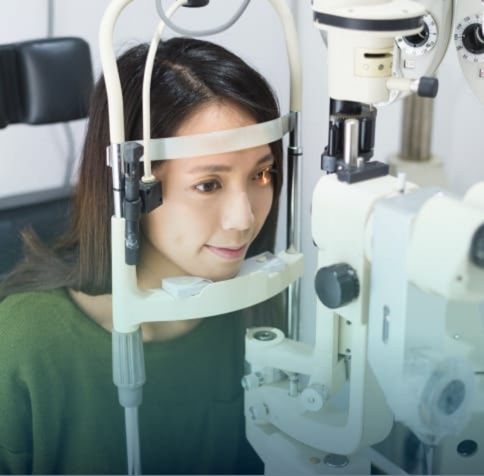
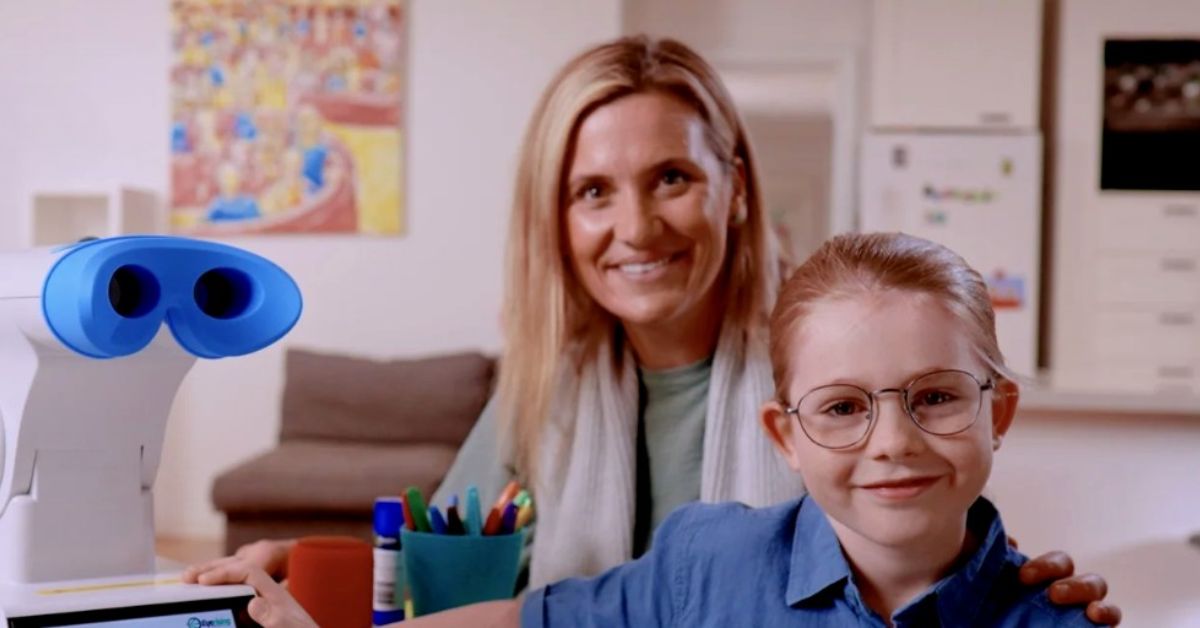
RLRL stands for repeated low-level red-light therapy. The child sits in front of a desktop device, places their eyes against the viewers, and looks at a soft red light for three minutes, twice per day, five days out of seven. The light is much gentler than the lasers used in surgical eye procedures and falls within international safety standards for clinical light exposure. The light source is LED.
The leading theory is that low-level red light stimulates the choroid which is a layer of blood vessels behind the retina, causing it to thicken. A thicker choroid is associated with slower eye growth, which is what we want when we’re trying to control myopia. Researchers are also looking at how the light may influence cellular energy production and dopamine signalling in the retina, both of which are thought to play a role in regulating how the eye grows.

“RLRL is genuinely novel, it’s not a different version of glasses, drops, or contact lenses. It works on the eye through light alone, which is part of what makes it interesting and part of what makes ongoing safety research so important.”
Safety Concerns: What Recent Retinal Studies Show
Through 2024, systematic reviews of the published RLRL trials concluded that the therapy appeared safe over the periods studied which was up to two years, with no cases of permanent vision loss. However, several recent findings have shifted the conversation:
- April 2025 retinal cone density study. A multicentre retrospective study of 99 myopic children found that those who had used RLRL therapy showed reduced foveal cone density (the photoreceptor cells responsible for fine, central vision), along with a higher incidence of abnormal retinal signals and drusen-like lesions, compared to children who hadn’t used the therapy.
- A previously published case report documented a child who developed temporary visual acuity loss and OCT (retinal imaging) abnormalities after RLRL treatment. Encouragingly, the changes resolved within four months of stopping therapy.
- Standard imaging may miss early changes. Most safety studies have relied on standard retinal imaging (photos), which can’t visualize photoreceptor cells at the cellular level. Newer techniques like adaptive optics imaging are now being used to look more closely.
- Long-term data are still limited. The longest published follow-up is roughly two to three years. We don’t yet know how the therapy affects the eye over five, ten, or twenty years.
- Rebound effects. Some children show a return to faster eye growth after stopping RLRL, raising questions about whether the treatment delays or truly reduces total myopia.
- Regulatory status in Canada. The leading RLRL device is approved in Australia, New Zealand, the UK, the EU, and China, but not by Health Canada or the FDA. This means it’s not currently a standard option in Canadian optometric practice.
None of this means RLRL is unsafe, it means we don’t yet have the long-term, high-resolution evidence we’d want before recommending it broadly for children in our practice.
Our position at Abbey Eye Care is that RLRL is a promising therapy worth following closely, but for now, we believe the more thoroughly studied options should be the starting point for most children. Treatments like specialty soft contact lenses (e.g. MiSight), orthokeratology (overnight contact lenses), novel spectacle lens designs (MiSight Spectacle and Stellest 2.0) and low-dose atropine eye drops have years of safety and efficacy data behind them and are the foundation of the evidence-based myopia management we provide today in our clinic.
That said, every family is different, and every child’s myopia is different. If you’re curious about RLRL, the best thing to do is bring it into the conversation at your child’s next eye exam. We can review the latest evidence with you, discuss how your child’s progression compares to peers, and help you weigh the options in a way that matches your family’s values and risk tolerance.
FAQ’s
Is red light therapy approved for myopia in Canada?
No. The main RLRL device used in published research is currently approved in Australia, New Zealand, the UK, the EU, and China, but it is not approved by Health Canada or the FDA. That means we have yet to offer it to patients in our clinic in Oakville.
If the early studies were so positive, why isn’t it more widely available?
Regulatory bodies tend to move cautiously with novel treatments, especially those involving direct light exposure to the developing retina. The recent retinal imaging studies have made that caution feel even more warranted. We expect a clearer regulatory picture as longer-term and more higher-resolution data become available.
What treatments do you recommend for myopia control instead?
For most children, we start with a combination of evidence-based options: increased outdoor time, specialty contact lenses such as MiSight, novel spectacle lenses such as Misight Spectacle or Essilor Stellest 2.0, orthokeratology – overngight contact lenses, and in some cases, low-dose atropine drops. The right combination depends on your child’s age, prescription, lifestyle, and how quickly their myopia is progressing.
Will you start offering RLRL in the future?
If and when the long-term safety evidence is reassuring and the therapy receives Health Canada approval, we’ll absolutely consider it as part of our myopia management toolkit. We’re committed to offering treatments that are both effective, safe and well-supported by the science.
Myopia management is one of the areas of optometry changing fastest, and that’s good news for your child, even if it means there’s more to discuss at each visit. If you’ve been reading about red light therapy, or simply wondering whether your child might benefit from a more proactive approach to their nearsightedness, we’d love to talk it through with you. Book a comprehensive eye exam at Abbey Eye Care, and we’ll give you a clear, honest picture of where the evidence stands and what we’d recommend for your child today.
BOOK YOUR CHILD’S EYE EXAM
Wondering whether your child’s vision has changed, or whether they might benefit from a myopia management plan? Our team at Abbey Eye Care in Oakville stays at the forefront of pediatric eye care and myopia management, and we’d love to help your family see the bigger picture. Book an eye exam today and let’s make sure their eyes are growing in the right direction.
OUR MYOPIA CLINIC
Worried about your child’s prescription climbing year after year? Our dedicated Myopia Clinic
offers proven management options which include: Spectacle lenses, Ortho-K, specialty soft contact lenses, and atropine therapy, all designed to slow myopia progression and protect the long-term eye health of you child.