Myopia Control Glasses: How Stellest 2.0 and MiSight Spectacle Lenses Slow Your Child’s Nearsightedness
Dr. Tina Goodhew
May 6, 2026
If your child has been squinting at the TV, sliding their books closer to their face, or coming home from school with new “I can’t see the board” complaints, you are not alone and you have more options today than parents did even five years ago. A new generation of specialty spectacle lenses, designed specifically to slow the progression of childhood nearsightedness, are now available in Canada. Two of the most talked-about are Essilor’s Stellest 2.0 and CooperVision’s MiSight Spectacle (DOT technology) lenses.
How Myopia Control Spectacle Lenses Actually Work
To understand these lenses, it helps to know what is really happening when a child becomes nearsighted. Myopia develops when the eye grows too long from front to back, causing distance vision to blur. Standard glasses correct that blur on the central part of the retina, but they don’t change the underlying signal telling the eye to keep elongating. In fact, research over the last two decades suggests that conventional lenses may encourage that growth and cause the prescription to increase.
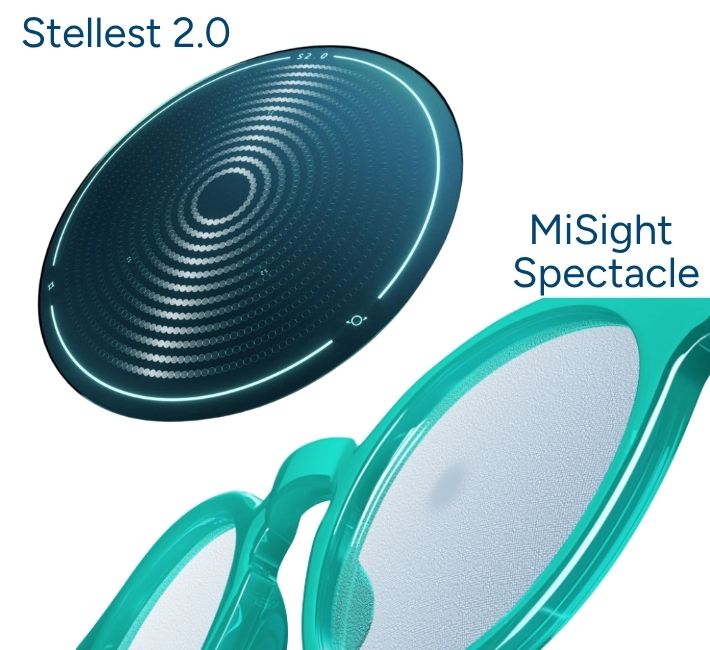
Myopia control spectacle lenses are different. They still give your child sharp central vision for school, sports, and near work, but they also gently alter how light lands on the rest of the retina, from the periphery of our vision, in a way that appears to tell the eye, “you’ve grown enough.” The two leading technologies in Canada accomplish this in very different ways: Stellest 2.0 uses a precise pattern of tiny lens shapes called lenslets, while the MiSight Spectacle lens uses a field of microscopic dots that reduce contrast in the peripheral vision.
Targeted Optics
These aren’t just glasses to help you child see in the distance, they are engineered to influence how the eye grows – keeping growth to a minimum.
Two Approaches
Stellest 2.0 creates a “shield” of myopic defocus with lenslets; MiSight Spectacle softens peripheral contrast with thousands of tiny dots.
Worn All Day
Both lenses replace your child’s regular glasses and need to be worn during all waking hours to deliver their full therapeutic effect.
Stellest 2.0 vs. MiSight Spectacle: Comparing the Evidence
Stellest 2.0 uses Highly Aspherical Lenslet Target or (H.A.L.T.) technology which consists of twelve concentric rings made up of more than a thousand tiny, invisible lenslets surrounding a clear central zone. Multi-year clinical trials in school-aged children have reported that, when worn full-time, Stellest 2.0 can slow myopia progression by roughly 60–70% compared to standard single vision lenses.
MiSight Spectacle lenses with Diffusion Optics Technology (DOT) take a different route. Thousands of microscopic light-scattering dots are embedded across the lens, leaving a clear central pupil zone for crisp vision. The dots gently reduce contrast in the peripheral retina, which research suggests may be one of the signals that drive rapid eye growth. Published trials have shown DOT lenses can slow progression by approximately 60-70% as well.
Both lenses are backed by published, peer-reviewed clinical evidence, and head-to-head comparisons in real-world clinical use have not crowned a definitive winner. The “best” lens for your child often depends on prescription, lifestyle, comfort with the visual experience, and how consistently they wear their glasses.
“Both Stellest 2.0 and MiSight Spectacle lenses offer meaningful, evidence-based slowing of myopia progression. The right choice is the one your child will wear every day.”
Is Your Child a Good Candidate for Myopia Control Lenses?
Myopia control spectacle lenses can be a wonderful option, but they are not the only choice, and they aren’t right for every child. During a comprehensive myopia management consultation, we look at several factors before recommending Stellest 2.0 or MiSight Spectacle lenses, or another approach such as soft daily disposable contact lenses, Ortho-K or atropine eye drops.
- Age and progression rate: Children whose myopia is changing quickly between eye exams generally benefit most from intervention.
- Prescription range: Both Stellest 2.0 and MiSight Spectacle lenses work best within specific prescription ranges; very high or very low prescriptions may need a different strategy.
- Family history: A parent or sibling with significant myopia raises your child’s likelihood of progression and strengthens the case for early treatment.
- Lifestyle and screen time: Children with heavy near-work demands or limited outdoor time tend to progress faster and benefit more from full-time lens wear.
- Comfort with glasses wear: Because these lenses must be worn essentially all waking hours to be effective, a child who already wears glasses is often an excellent candidate.
The good news is that we can take the guesswork out of this decision together. Using specialized testing such as axial length measurements, refraction trends, corneal topography and a careful conversation with you and your child to choose the most suitable treatment option.
FAQ’s
Will my child still see clearly with Stellest2.0 or MiSight Spectacle lenses?
Yes. The central zone of both lenses provides clear, sharp vision for everyday activities. Most children adapt within a few days, similar to switching to any new prescription.
How long will my child need to wear myopia control glasses?
Treatment typically continues until the eyes have largely stopped growing which is usually somewhere in the mid-to-late teen years. We monitor progress every 6 months and adjust the plan as your child develops.
Are these lenses covered by insurance in Canada?
Many extended health benefit plans cover prescription eyewear, including specialty myopia control lenses, but coverage varies. Our team is happy to help you check your benefits before you commit.
What if glasses aren’t the right fit for my child?
There are excellent alternatives, including MiSight 1 day soft contact lenses and overnight orthokeratology (Ortho-K). At Abbey Eye Care we offer the full range of Health Canada approved myopia management options and will help you choose the best one for your child.
Can these be used with astigmatism?
Yes. Stellest 2.0 and MiSight Spectacle lenses all both available with cylinder correction for astigmatism. The treatment zones are designed to work independently of the astigmatic component of the prescription. There are however some practical limits with higher astigmatism values. Please discuss with your optometrist if the prescription is complex.
BOOK YOUR CHILD’S EYE EXAM
Wondering whether your child’s vision has changed, or whether they might benefit from a myopia management plan? Our team at Abbey Eye Care in Oakville stays at the forefront of pediatric eye care and myopia management, and we’d love to help your family see the bigger picture. Book an eye exam today and let’s make sure their eyes are growing in the right direction.
OUR MYOPIA CLINIC
Worried about your child’s prescription climbing year after year? Our dedicated Myopia Clinic
offers proven management options which include: Spectacle lenses, Ortho-K, specialty soft contact lenses, and atropine therapy, all designed to slow myopia progression and protect the long-term eye health of you child.