Building a Myopia Management Plan: What a Comprehensive Approach Looks Like
Dr. Tina Goodhew
June 16, 2026
When your optometrist says your child’s nearsightedness is progressing, the first question most parents ask is simple: what can we do about it? The reassuring answer is that managing myopia is no longer a matter of stronger glasses each year. It is a thoughtful, personalized plan built around your child, and understanding how that plan comes together makes the whole journey far less daunting.
Myopia Management Is a Process, Not a Product
It is tempting to think of myopia control as a single thing you buy: special contact lenses, a bottle of eye drops, a pair of glasses. In practice, the treatment is only one piece of something larger. The real work is the ongoing relationship between your child, your family, and your optometrist over the years while the eyes are still growing and changing.
A good plan does three things well. It starts with a careful assessment so we understand exactly what is happening inside the eye. It then matches the right treatment, or combination of treatments, to your child’s needs and daily life. And it keeps measuring the effectiveness of that treatment over time so the plan can adapt as your child grows. Everything that follows in this article walks through those three stages.
Assess
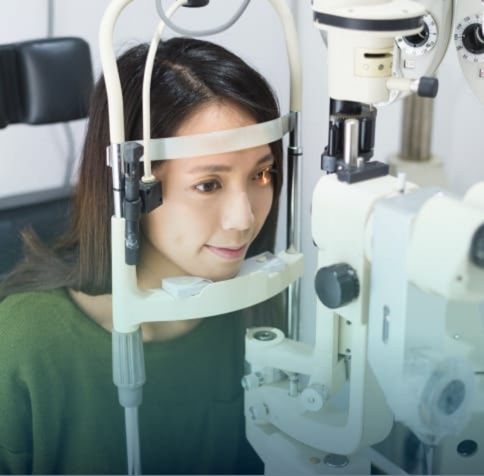
A thorough exam that goes beyond the prescription to measure the length of the eye and the rate of change. This is the foundation everything else is built on.
Treat
The right approach for your child, chosen from several proven options and sometimes combined, with everyday lifestyle changes that help support whichever path we take.
Monitor
Regular follow-up visits that track whether the plan is working, so we can adjust early rather than the eye to grow and change too quickly.
Step One: A Thorough Myopia Assessment with Your Optometrist
Every good plan begins with a clear picture of what we are managing. A myopia baseline assessment is more detailed than a standard eye exam, because slowing progression means we need to understand not just how your child sees today, but how quickly their eyes are changing.
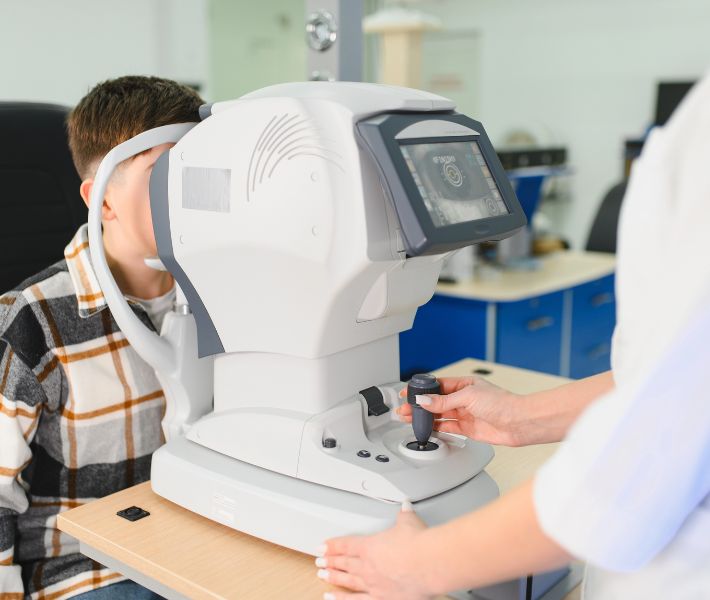
We start with the refraction, which is the measurement that gives us the glasses or contact lens prescription. On its own, though, a prescription only tells part of the story. The more important measurement in myopia management is axial length, the front-to-back distance of the eyeball. Myopia progresses largely because the eye is growing too long, so tracking that length over time is the most reliable way to see what is really happening.
We also review your child’s history. How fast has the prescription changed in the past year or two? When did myopia first appear, and how nearsighted are the parents? Younger onset and a strong family history both point to a higher likelihood of faster progression, which impacts the type or types of treatment we recommend.
Finally, we check the overall health of the eyes to rule out anything else and to establish a healthy baseline. At Abbey Eye Care this assessment is the same starting point for every child, whether myopia has just appeared or has been climbing for years.
If your child is not yet nearsighted but shows early signs of risk, the same assessment helps us catch it before it begins. We cover that earlier stage in our article on spotting and managing pre-myopia in children, which pairs naturally with this one for families who want to get ahead of it.
Choosing the Right Treatment, or Combination of Treatments
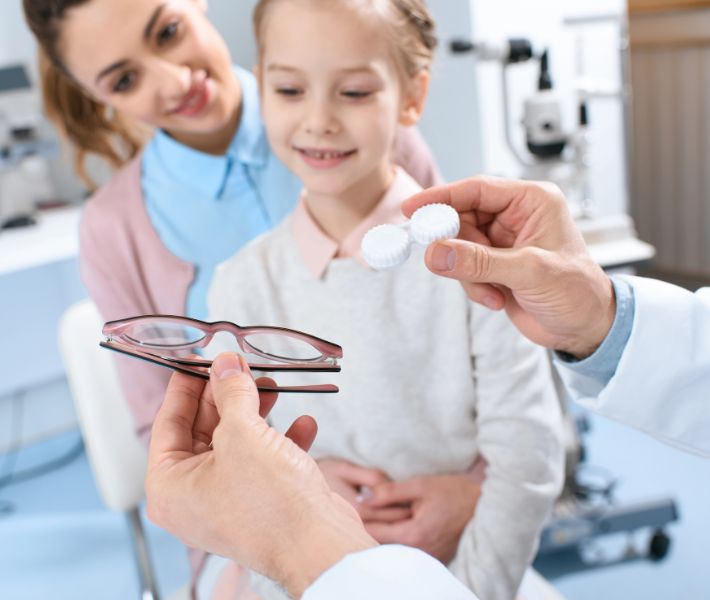
Once we understand how your child’s eyes are behaving, the next step is matching them to a treatment. There is no single best option that suits every child. The right choice depends on the prescription, how fast it is changing, your child’s age, and the realities of their daily life. Today families have several well-studied treatment options to choose from.
Orthokeratology (Ortho-k)
uses rigid lenses worn overnight that gently reshape the cornea, giving clear daytime vision with no glasses and slowing myopia progression at the same time. We explain it fully in our guide to ortho-k for children.
Soft myopia control contact lenses
such as MiSight are worn during the day and suit children who are comfortable with daytime contacts but would rather not sleep in lenses.
Myopia control spectacle lenses
like Stellest and MiSight Spectacle. These are a glasses-only option, which appeals to younger children or families who prefer to avoid contacts entirely.
Low-dose atropine eye drops
work through a different pathway and can be used alone or alongside an optical treatment. We cover them in detail in our article on atropine for myopia control.
Sometimes the strongest plan combines two of the above. A child whose myopia is progressing quickly might wear myopia control glasses during the day and use low-dose atropine drops at night, so that an optical treatment and a pharmaceutical one work together. Combining approaches is a clinical decision we make carefully, based on how the eyes respond, and it is one of the clearest reasons to think of this as a personalized plan rather than a product off a shelf.
“The best treatment is the one your child will actually use every day. Part of our job is matching the science to the realities of family life, then adjusting as your child grows.”
Lifestyle Modifications That Support Every Treatment Plan
Whichever treatment we choose, lifestyle modifications give it the best possible chance to work. These changes will not replace a clinical treatment for a progressing eye, but the research is consistent enough that we recommend them for every child in our care.
- Time outdoors: Aim for around two hours of outdoor time each day. Natural daylight appears to slow the eye’s growth, and it is one of the simplest, most powerful habits a family can build.
- The 20-20-20 rule: Every 20 minutes of close work, look at something about 20 feet away for 20 seconds. It gives the eyes focusing system a regular rest.
- Mind the working distance: Encourage your child to hold books and screens at a comfortable arm’s length rather than right up to their face.
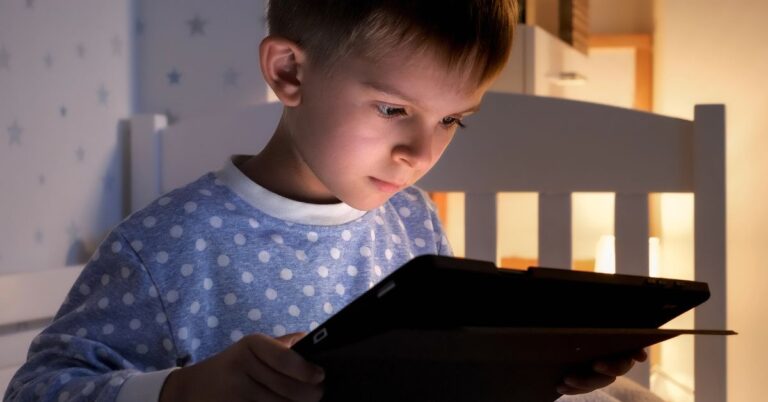
- Manage screen time: Long, unbroken stretches of close screen work are best broken up with movement and distance breaks. We recommend at least a 5 minute break for every hour of screen time.
- Good lighting: Reading and homework are easier on growing eyes in a well-lit space rather than a dim one.
None of these habits is difficult on its own. Woven into a daily routine, they quietly reinforce whatever treatment your child is using.
Monitoring Progress: Axial Length, Prescription, and the Bigger Picture
Starting a treatment is not the finish line. It is the point where careful monitoring begins. Because the eyes are still growing, we follow your child closely to confirm the plan is doing its job and to adjust it the moment the picture changes.
At follow-up visits, usually every six months, we look at two measurements side by side. The prescription tells us how your child’s vision is changing day to day. Axial length tells us what is happening structurally, since slowing the lengthening of the eye is the deeper goal of myopia management. Watching both together gives a far truer reading than the prescription alone.
We compare those numbers against your child’s own history and against what we would expect for their age. A plan that is working shows a clear slowing of progression compared to where things were heading if no treatment was given. If the eye keeps lengthening faster than we would like, that is our signal to adjust, perhaps by changing the treatment, increasing it, or combining approaches.
The reason we work so hard to slow progression is not the strength of the glasses. It is long-term eye health. Higher myopia carries a greater lifetime risk of conditions like retinal detachment and glaucoma, so every diopter we prevent now protects your child’s eyes for decades to come.
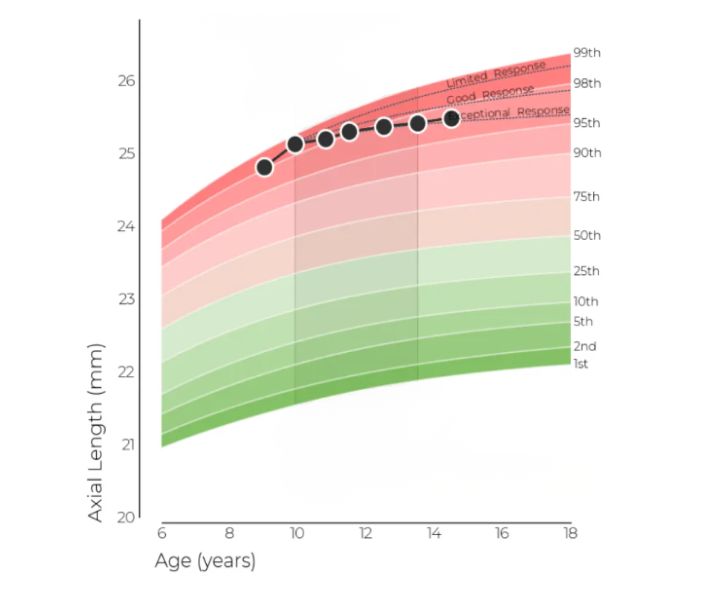
If you are not measuring the length of the eye you are not managing myopia.
Measuring success in myopia management is less about a single perfect result and more about the trend over time. A plan that keeps your child’s eyes growing slowly and steadily, year after year, is doing exactly what it should.
FAQ’s
How is a myopia baseline exam different from a regular eye exam?
A regular exam tells us your child’s prescription and checks the health of the eyes. A myopia assessment adds measurements that track progression, most importantly axial length, the front-to-back size of the eye. It also looks closely at how quickly the prescription has been changing and at family history, so we can predict how actively to manage things. The goal is not just to correct vision today, but to slow how fast it changes.
Can my child use more than one treatment at the same time?
Yes. For children whose myopia is progressing quickly, we sometimes combine an optical treatment, such as myopia control glasses or contacts, with low-dose atropine drops. The two work through different mechanisms and can complement each other. Combining treatments is a decision we make based on how your child’s eyes respond, and it is one of the advantages of a plan tailored to the individual child.
How often will my child need follow-up visits?
Most children on a myopia management plan are seen every six months. These visits let us measure the prescription and axial length, confirm the treatment is working, check eye health, and make any adjustments. Regular follow-up is what allows us to catch faster-than-expected progression early rather than a year down the road.
How will we know if the plan is actually working?
Success is measured by the trend over time, not a single visit. We compare your child’s prescription and axial length against their own history and against what we would expect for their age. A working plan shows a clear slowing of progression compared to where things were heading. If the numbers are not moving the way we want, we adjust the plan.
BOOK YOUR CHILD’S EYE EXAM
Wondering whether your child’s vision has changed, or whether they might benefit from a myopia management plan? Our team at Abbey Eye Care in Oakville stays at the forefront of pediatric eye care and myopia management, and we’d love to help your family see the bigger picture. Book an eye exam today and let’s make sure their eyes are growing in the right direction.
OUR MYOPIA CLINIC
Worried about your child’s prescription climbing year after year? Our dedicated Myopia Clinic
offers proven management options which include: Spectacle lenses, Ortho-K, specialty soft contact lenses, and atropine therapy, all designed to slow myopia progression and protect the long-term eye health of you child.