Ortho-K for Kids: How Overnight Contact Lenses Slow Myopia While Your Child Sleeps
Dr. Tina Goodhew
July 21, 2026
Imagine your child slipping in a pair of contact lenses at bedtime, sleeping through the night, and waking up able to see the board at school without glasses or daytime contacts. That is the everyday reality of orthokeratology, and for many Oakville families it has become one of the most reassuring tools we offer for managing a child’s nearsightedness (myopia). This guide walks you through how ortho-k works, who it suits, what the safety picture really looks like, and how it compares to the other myopia control options that we offer.
What Ortho-K Actually Is
Orthokeratology, usually shortened to ortho-k, uses custom-fitted rigid contact lenses worn only while your child sleeps. The lenses do their work overnight and are taken out in the morning. There is nothing in your child’s eyes during the school day, the soccer game, or the swim lesson.
Two things make parents lean in when they first hear about it. The first is the freedom: no glasses to lose, no daytime lenses to fuss with. The second, and the more important one clinically, is that ortho-k is one of the best-studied ways to slow down how quickly a child’s nearsightedness gets worse as they grow. You get a practical daily benefit and a long-term eye health benefit from the same treatment.
Worn Overnight Only
Your child puts the lenses in at bedtime and removes them upon awakening. The correction happens while they sleep, so their days are completely lens-free.
Clear Vision by Day
The gentle overnight reshaping holds through the day, giving most children clear distance vision without glasses or daytime contacts.
Slows Myopia Progression
Beyond convenience, ortho-k has strong long-term evidence for slowing the eye growth that drives your childs myopia to worsen over time.
How Ortho-K Works: Reshaping the Cornea Overnight
Nearsightedness, or myopia, develops when the eyeball grows a little too long from front to back. Light then focuses just in front of the retina instead of landing right on it, and distant objects look blurry. The cornea, the clear dome at the very front of the eye, is where ortho-k does its work.
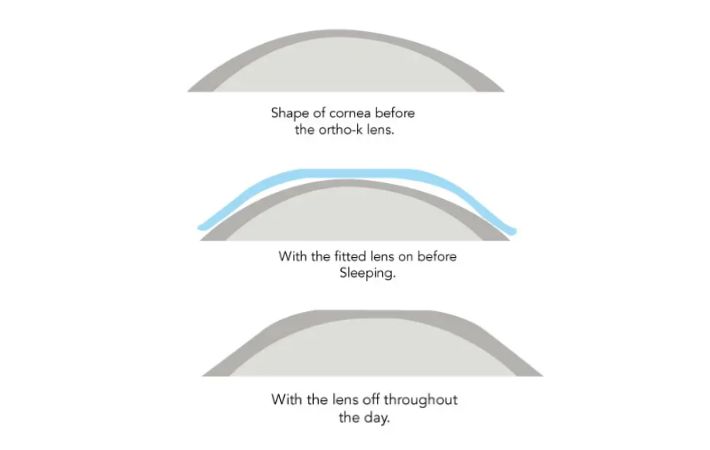
An ortho-k lens is shaped to apply the gentlest pressure to the tear film over the cornea, encouraging the surface cells to redistribute very slightly overnight. The centre of the cornea flattens by a tiny, precisely calculated amount. That small change is enough to bring distance vision into focus the next day, and it is fully reversible. If your child stops wearing the lenses, the cornea gradually returns to its original shape within a few days.
There is a second effect that matters even more for long-term eye health. By reshaping the cornea, ortho-k changes how light lands on the peripheral retina, the outer edges of the light-sensing tissue. That shift sends a signal that helps slow the eye’s tendency to keep elongating. In plain terms, it eases off the very growth that makes myopia worse year after year.
“The same lens that lets your child wake up and see clearly is also quietly working to keep their prescription from climbing as fast as it otherwise would.”
Is Your Child a Good Candidate for Ortho-K?
Ortho-k is not the right fit for every child, but it suits a surprisingly wide range of them. The best way to know is through a fitting consultation, where we map the surface of your child’s cornea and review their prescription, eye health, and daily routine. A few patterns tend to point toward ortho-k being a strong option.
- Age and maturity: Children as young as 7 or 8 can do well with ortho-k. What matters more than age is whether the child, with a parent’s help, can handle the bedtime and morning routine consistently.
- Prescription range: Ortho-k works best for low to moderate myopia, and modern lens designs have widened that range. Some astigmatism can also be corrected. We confirm the numbers at the consultation.
- Active lifestyle: Kids in sports, swimming, dance, or anything where glasses get in the way often love being lens-free during the day. Ortho-k is a natural fit for active families.
- Progressing myopia: If your child’s prescription has been climbing at each visit, the myopia-slowing effect of ortho-k becomes a real reason to consider it sooner rather than later.
- Healthy eyes and good tear quality: Children with significant dry eye or certain corneal conditions may need a different approach, which is exactly what the fitting assessment is designed to catch.
If ortho-k is not the right match, that is genuinely useful information too. It simply points us toward one of the other very effective myopia control options that we have at our disposal.

The first question almost every parent asks is whether it is safe to sleep in contact lenses. It is a fair question, and the honest answer is that ortho-k has a well-documented safetyprofile when the lenses are fitted properly and cared for the right way. The lenses are made from a highly breathable material that lets oxygen reach the cornea overnight.
The main thing to manage is hygiene. Like any contact lens, ortho-k carries a small risk of eye infection if the lenses are not cleaned correctly. The good news is that this risk is very low and almost always preventable with a simple, consistent routine. Hands are washed and dried before handling lenses, the lenses are cleaned and stored exactly as instructed, and solutions and cases are replaced on schedule.
For younger children, a parent typically supervises the routine at first and then steps back as the child becomes confident. We walk your whole family through every step at the fitting and we schedule regular check-ups to confirm the eyes stay healthy and the fit stays right. Ongoing oversight is a big part of what makes ortho-k safe.
A handful of habits keep ortho-k comfortable and trouble-free, and they become second nature within the first couple of weeks:
- Wash and dry hands thoroughly before inserting or removing the lenses.
- Use only the cleaning and storage solutions we recommend, never water or plain saline on its own.
- Replace the lens case regularly and let it air dry between uses.
- Wear the lenses every night, or as directed, to keep daytime vision stable.
- Call us promptly if an eye becomes red, painful, or unusually sensitive to light.
Ortho-K vs. Other Myopia Control Options: Making the Right Choice
Ortho-k is one of several proven ways to slow myopia in children, and no single option is automatically best for every child. The right choice depends on your child’s prescription, age, lifestyle, and comfort with the routine. Here is how ortho-k sits alongside the other main approaches we offer.
- Soft myopia control contact lenses: Daily disposable lenses such as MiSight and Abiliti are worn during the day and slow progression through a similar peripheral-focus effect. They suit children who would rather not wear lenses overnight but are comfortable handling lenses during the day.
- Myopia control spectacle lenses: Specialty glasses such as Stellest 2.0 and MiSight Spectacle use a patterned lens surface to slow eye growth while correcting vision. They are a strong fit for children who are not yet ready for contact lenses of any kind.
- Low-dose atropine eye drops: A nightly drop that slows progression through a different, biochemical pathway. Atropine can be used on its own or paired with an optical treatment for children whose myopia is advancing quickly.
- Ortho-k: The standout when a family values lens-free days and a child is active in sports or swimming. It delivers both clear daytime vision and proven myopia slowing, with no daytime correction to manage.
Because some of these approaches work through different mechanisms, they can sometimes be combined for children with rapidly progressing myopia. What matters most is that the plan is chosen for your child specifically and reviewed as they grow. That is the conversation we love having with parents.
Frequently Asked Questions
Does putting in the lenses hurt my child’s eyes?
Most children adjust quickly. There can be a mild awareness of the lenses for the first few nights as the eyes get used to them, but this usually fades fast, especially since the lenses go in right before they go to sleep. By the time your child is drifting off, the sensation has typically settled.
How soon will my child see clearly without the lenses?
Many children notice a real improvement after the first night or two, with vision becoming sharper and more stable over the first week of consistent wear. We provide a clear timeline at the fitting and check progress closely during those early weeks.
What happens if my child stops wearing ortho-k lenses?
The effect is fully reversible. If your child stops wearing the lenses, the cornea gradually returns to its original shape within a few days, and their previous prescription comes back. Nothing about ortho-k permanently alters the eye, which is one of the reasons parents find it reassuring.
Do we need a referral to try ortho-k?
No referral is needed. You can book a myopia consultation directly with us. We will assess your child’s eyes, map the shape of the cornea, and talk through whether ortho-k or another myopia control option is the better fit for your family.
BOOK YOUR CHILD’S EYE EXAM
Wondering whether your child’s vision has changed, or whether they might benefit from a myopia management plan? Our team at Abbey Eye Care in Oakville stays at the forefront of pediatric eye care and myopia management, and we’d love to help your family see the bigger picture. Book an eye exam today and let’s make sure their eyes are growing in the right direction.
OUR MYOPIA CLINIC
Worried about your child’s prescription climbing year after year? Our dedicated Myopia Clinic
offers proven management options which include: Spectacle lenses, Ortho-K, specialty soft contact lenses, and atropine therapy, all designed to slow myopia progression and protect the long-term eye health of you child.